
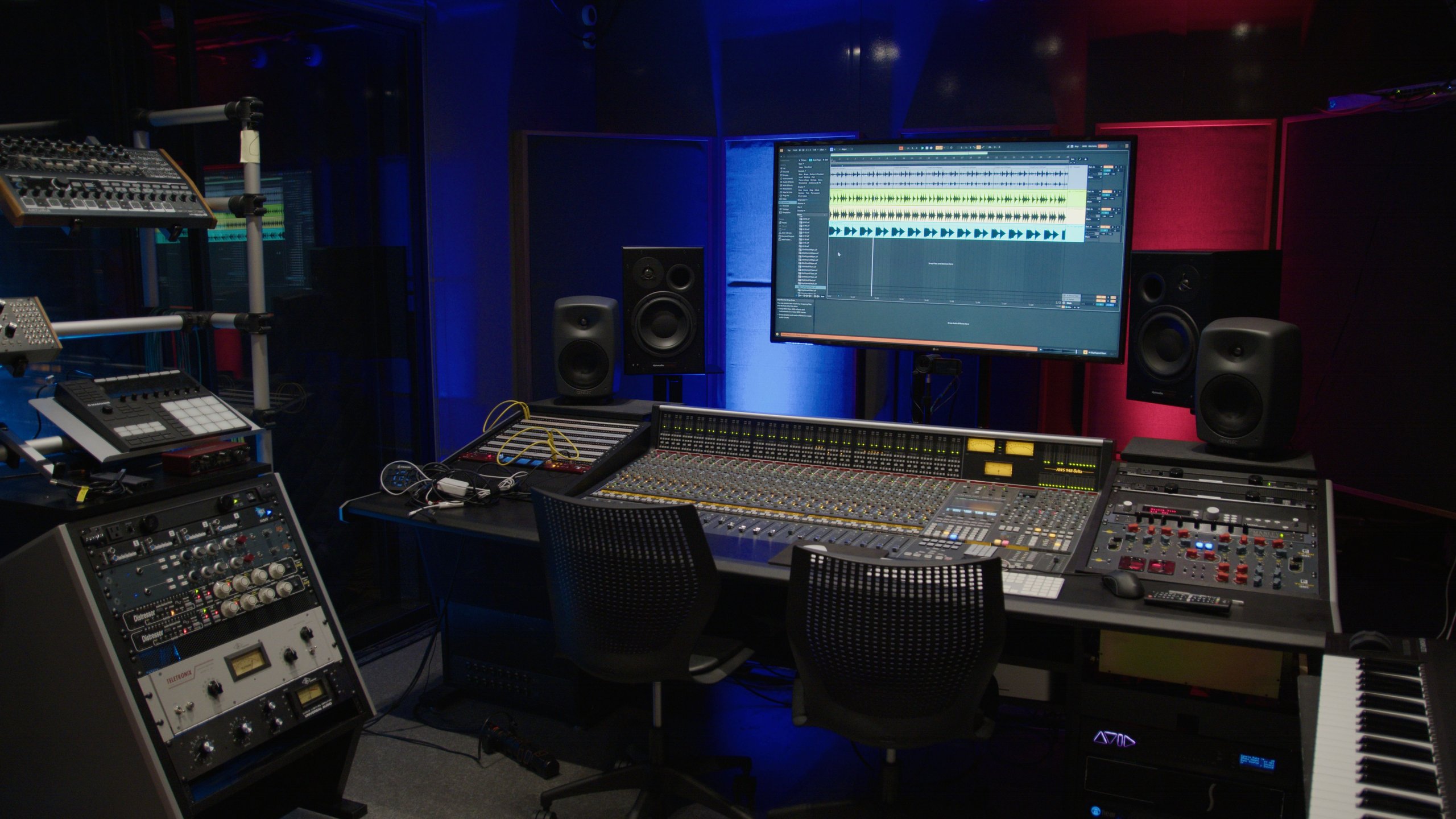
There’s more than one way into the studio
You can learn a lot about studio engineering from videos. You can learn Pro Tools shortcuts, how a compressor works and what a patchbay is for. But when recording scenarios unfold in real time:
- A drummer can’t hear the click when recording
- The snare mic is picking up more hi-hat than snare
- A mysterious hum is being picked up in the overhead
In-person problems like these (and more) necessitate in-person solutions. You need to learn what can go wrong while recording, how to efficiently problem solve and how to find solutions to maintain creative momentum in the room.
Situations like these are why people learn engineering in person. Maybe you’ve been recording vocals at home for two years and they still sound small. Maybe a friend’s band asked you to record their EP and you’ve never set up more than one mic. Maybe you mix other artists’ tracks for free and want to be good enough to charge. Maybe you want to assist at a commercial studio and have no idea how anyone gets in the door.
Each of those people need something different, and in-person learning comes in more than one format. This guide covers what each one is for, who it suits, when to skip it, and how people combine them. First, a quick note on the name…
Audio Engineering, Sound Engineering, Studio Engineering: Why We Use The Term We Do
You’ll see all three terms when you start looking for training, often on the same school’s website. They overlap, and they don’t mean quite the same thing.
Audio Engineering is the widest. It covers anyone who records, mixes or reproduces sound, which includes live sound at concerts, broadcast, post-production for film and TV, game audio and podcasts, as well as music recording. Those jobs share some fundamentals and then go in very different directions.
Sound Engineering is mostly used as another name for audio engineering. The U.S. Bureau of Labor Statistics calls the job “sound engineering technician” and lists “audio engineer” as an alternate title. The emphasis shifts with where you are. In the U.S., people often hear “sound engineer” and picture the person at the front-of-house desk at a concert. In the UK, it’s also the everyday word for someone recording in a studio.
Studio Engineering is the part we teach: recording and mixing music in a studio. Placing mics on a drum kit. Getting a vocalist a headphone mix they’re comfortable with. Routing a signal through the patchbay into a hardware compressor and back into Pro Tools. Running a session so the artist can focus on the performance.
We use the narrower name because it tells you where you’ll be working. A class called “audio engineering” or “sound engineering” might spend its hours on live sound or film post, and that’s worth checking before you enroll anywhere.
The In-Person Options at a Glance
| Option | Typical Commitment | Best For | The Tradeoff |
| Four-Year Degree | Four years, full-time | People who want the credential and the college experience | Highest cost, and studio time is shared across a large program |
| Associate Degree or Community College Program | Two years, often part-time friendly | A structured, lower-cost start with a credential | Studio facilities and hours vary a lot by school |
| Dedicated Audio School or Certificate Program | Months to about a year, usually full-time | Career changers who can step away from work | Significant tuition for a short, intense stretch |
| Apprenticeship Program | Several months, scheduled with a mentor | Learning inside a working studio | Quality depends almost entirely on the mentor |
| Intern | Open-ended | People already in the room who want to work their way up | Long hours, low pay, and hard to land with no skills |
| Short In-Person Courses | Four to six weeks, evenings and weekends | Building specific skills while keeping a day job | No degree, and you choose your own sequence |
| Private Lessons | One session at a time | A specific problem or a specific goal | Least structure, most self-direction |
| Free Workshops | An evening | Finding out whether engineering is for you | A taste, not training |
Four-Year Degree Programs
Universities offer bachelor’s degrees in music technology, recording arts and audio production. You get four years of structured study, usually music theory and acoustics alongside the recording work, access to campus studios, and a degree at the end.
A degree makes the most sense when the credential itself matters to you. Teaching, audio research, acoustics and technical roles at larger companies are all places where it can count. It also suits people who want the full college experience and are at a point in life where four years of full-time study works.
The tradeoffs are cost and access. Tuition is the highest of any option here, and campus studios are shared by everyone in the program. Before you apply, ask how many hours each student actually gets on the console.
Associate Degree or Community College Programs
Two-year programs in audio or recording technology cover the fundamentals at a lower cost than a four-year school, and many are built to work around a job. You come out with a credential and a foundation you can build on, either in the workforce or by transferring.
Facilities are the big variable. Some programs run well-equipped studios. Others are mostly classroom and computer lab. Tour the studio before you enroll, and ask how much of the program happens in it.
Dedicated Audio Schools and Certificate Programs
These are focused programs, typically months to about a year of full-time study, built entirely around audio. No general education, a lot of lab time, and a clear endpoint.
They suit people who know engineering is what they want and can step away from work for a stretch. The pace is intense and the tuition is significant for the length of the program.
One thing specific to New York: some of the city’s long-running dedicated audio schools have closed or stopped enrolling over the last decade. Check that a program is currently accepting students, and ask how long its current studio setup has been in place, before you plan around it.
Apprenticeship Programs
Some paid programs place you with a working engineer and you learn in their studio, on their sessions. At its best, this is close to how engineers learned before schools existed: you watch real work, then you do it with someone checking you.
The experience depends almost entirely on who your mentor is, how busy their studio is and how much of the session they actually hand to you. Ask to meet the mentor first, ask what a typical week looks like, and ask what past students are doing now.
Intern
The traditional route into commercial studios. You start as an intern or runner, doing whatever the studio needs, and wait for an assistant engineer spot to open. Berklee’s career guide describes assistants spending anywhere from one to five years in the role before moving up, with 12-hour days, nights and weekends, and low starting pay. The payoff is a real education from inside working sessions.
It’s still one of the most direct paths to engineering records for a living. The catch is getting in. Studios want someone who already understands signal flow, can set up a session without being shown twice and knows how to behave around an artist. Most people who land these roles got some training first, and that’s where the structured options above come in.
Short In-Person Courses
Part-time courses run a few weeks each, in the evenings or on weekends, and each one covers a specific set of skills. You keep your job, you choose what to learn next, and you can stop or keep going depending on how it’s going.
They suit people who are testing the waters, producers adding recording and mixing skills to their own work, and anyone preparing to go after an assisting job. You don’t get a degree, and you’re responsible for your own sequence, so look for a school that lays out a clear path from intro to advanced.
Private Lessons
One-on-one time with an instructor on whatever you need. A mix that won’t come together, a specific piece of gear, a session you have coming up. Private lessons are efficient when you know exactly what you’re stuck on, and they’re a useful add-on to any of the options above. They’re a poor substitute for a foundation, because you end up paying one-on-one rates to cover basics a class would teach.
Free Workshops
Before committing money to any of the above, spend an evening in a real studio. Many schools run free intro workshops, and most will show you around if you ask. You’ll learn quickly whether patching a console and setting up mics is something you’d enjoy doing for hours at a time.
How to Choose
Start with the job you want. Recording & mixing music, live sound, and post-production are different enough that the right program for one can be the wrong program for another.
Then be honest about your time. A full-time program means stepping away from work for months or years. Part-time study fits around a job and takes longer to add up.
After that, these questions will tell you more about a program than its website will:
- How many hours will I personally spend operating a console, not watching one?
- How many students share the studio, and can I book it outside class?
- Who teaches, and what have they recorded or mixed?
- What gear is in the room, and is it maintained?
- What are recent students doing now?
- Is the program currently enrolling, and what does it cost in total, including fees?
For studio work specifically, what you can do in a session and who will vouch for you tend to count for more than the paper. Pick the option that gets your hands on real gear most often, with someone experienced watching.
Where Sound Collective Fits
Sound Collective is a music school and studio at 28 Broadway in Lower Manhattan. We teach studio engineering as short, part-time, in-person courses in our own recording studio, with an optional full program for people who want the whole path.
We’re not a degree program, and we don’t teach live sound (yet) or post-production for film. If either of those is your goal, one of the other options above will serve you better.
The Core Courses
Intro to Studio Engineering covers audio fundamentals, mics and mic technique, signal flow and the patchbay, outboard processing, SSL console workflow, and mixing and session delivery.
Intermediate Studio Engineering is about running a commercial recording session on your own, from setup and tracking to clean, mix-ready files.
Advanced Studio Engineering is the capstone, covering complex sessions, analog integration, and client and artist management. Studio Essentials courses in mixing, mastering, ear training, digital engineering and analog engineering go deeper on one area each.
Studio Essentials
Shorter, focused courses on one part of the craft. Take them alongside the core sequence or on their own. Each one is 12 hours over four to six weeks.
Studio Essentials: Mixing takes a complete multitrack session to a finished mix. Gain staging, corrective and creative EQ, compression, spatial processing, and bus processing and export.
Studio Essentials: Mastering picks up where mixing ends and turns finished mixes into release-ready masters. It covers building a mastering chain, tonal EQ, dynamics, stereo width and limiting, and delivering masters that hold up on streaming, club systems and everyday speakers.
Studio Essentials: Ear Training teaches you to hear problems before you look for them on a screen. Frequency recognition, compression and dynamics, saturation and phase, pitch and timing, and consistent critical listening habits.
Studio Essentials: Digital Engineering builds on intro-level Pro Tools with a professional digital recording and editing workflow. Complex routing and submixing, clean editing, sample rate and bit depth, and plugin processing for tracking and mixing.
Studio Essentials: Analog Engineering puts you on the console and outboard as your main tools. Analog console operation, outboard compression and EQ, hybrid analog and digital signal chains, and basic hardware maintenance.
The Format
Each course includes 12 hours of instruction over four to six weeks. That includes practice time on class days, 6 day passes for the days you’re not in class, and a certificate of completion. No gear or Pro Tools license needed.
The Full Program
The Studio Engineering Full Program runs the path in three sections over 12 months, with an additional 12 hours of one-on-one mentorship per section. It ends with a full session with outside players that you plan, track, mix and master yourself.
The Studio
An SSL AWS 948 Delta console, an outboard rack with an API 3124V preamp, BAE 1084s, Empirical Labs Distressors, a Teletronix LA-2A, a Universal Audio 1176LN, a Manley Enhanced Pultec and a Bricasti Model 7 reverb, plus a large iso room that fits a full band and a small iso booth for overdubs.
FAQs
Is studio engineering the same as audio engineering? Studio engineering is one part of audio engineering. Audio engineering also includes live sound, broadcast, post-production and game audio. Studio engineering is the recording and mixing of music in a studio, and it’s the part Sound Collective teaches.
What’s the difference between sound engineering and audio engineering? Usually nothing. The terms are used interchangeably, and the BLS lists audio engineer as another name for a sound engineering technician. In the U.S., “sound engineer” often suggests live sound at concerts and theaters. In the UK, it’s the common term for studio work as well. If a course uses either name, read the syllabus to see where the hours are actually spent.
Does Sound Collective teach sound engineering? We teach the studio side of it: recording, mixing and running sessions in a recording studio. We don’t teach live sound, theater sound or post-production for film.
Do I need a degree to become a recording engineer? No. According to the BLS, education for sound engineering work ranges from a high school diploma to a college degree, and on-the-job training is common. A degree helps for some roles, like teaching and technical positions. In commercial studios, skills and references usually carry more weight.
How long does it take to learn studio engineering? A few months of focused, hands-on study covers the fundamentals of running a recording session. Getting good enough to engineer for paying clients takes years of sessions, whichever route you take. Assistant engineers often spend one to five years in that role before moving up.
What’s the difference between a studio engineer and a music producer? A producer shapes the music itself: the arrangement, the sounds, the performances, the overall direction. An engineer captures and mixes it: mics, signal flow, the console, the session. Plenty of people do both, and on smaller projects one person often does.
Can I learn studio engineering online? Part of it. Pro Tools, editing, mix theory and mastering all work well online, and Sound Collective has online studio engineering courses for those. Mic technique on live sources, console operation, outboard gear and running a tracking session need a real studio.
I have no experience. Where should I start? Come to a free workshop or take a studio tour first. If you like it, an intro course is the next step. At Sound Collective that’s Intro to Studio Engineering, and it assumes no experience.
Does Sound Collective offer a degree? No. Each course comes with a certificate of completion. The full program is a structured 12-month path with one-on-one mentorship and portfolio projects, not an academic degree.
Where is Sound Collective? 28 Broadway in Lower Manhattan, right by Bowling Green on the 4/5. Open Monday to Saturday 10am to 9pm, and Sunday 11am to 6pm.
Ready to start?
If a short, in-person course is the right fit, browse our in-person studio engineering courses and pick a start date. Intro to Studio Engineering is where most people begin. For the full path, see the Studio Engineering Full Program.
Still deciding? Come to a free Recording Basics or Mixing Basics workshop, or book a tour of the studio at 28 Broadway. We’ll tell you honestly whether our courses or another route makes more sense for what you want to do.
Questions? Call (646) 747-0144 or email admissions@soundcollective.com.