
Can you learn music production from YouTube?
Yes, a lot of it. YouTube music production tutorials are a good way to learn what a compressor does, where the sidechain input lives in your DAW, or how a producer you like programs drums. What a video can’t do is hear your track. It can’t tell you why your mix sounds muddy in the car, or why every idea you start gets stuck at 8 bars. That takes another person listening to your music, and it’s the main thing in-person music production classes add.
Here’s how it usually goes. You watch a sidechain tutorial and it makes sense. You watch it again to be sure. Then you open your own session, set it up the way the video did, and the kick still gets buried under the bass. So you search a more specific version of the question. Two hours later you’ve watched six videos and the track is exactly where it was when you started the rabbit hole.
The problem was specific to that session and those two sounds, and a tutorial has no way to hear it. This guide compares the two ways of learning: what YouTube does well, where in-person training does better, and how producers use both.
What YouTube music production tutorials do well
YouTube is best at specific questions with specific answers. How do I resample in Ableton? What does the attack knob on this compressor change? How are UK garage drums usually swung? Each of those has a good five-minute video, and it’s free.
It’s also where a lot of people go first to learn anything. In a 2018 Pew Research Center survey, 51% of U.S. YouTube users said the site was very important for figuring out how to do things they hadn’t done before.
For producers, a few things stand out:
- Answers when you need them: You hit a wall at midnight, search it, and usually find an answer before you lose the idea.
- Range: There are tutorials for every major DAW, most plugins, and genres no school near you teaches. If you’re into a niche style, someone on YouTube is probably making it and explaining how.
- Watching working producers: Some of the most useful videos show a producer you respect building a track from an empty session. You see the order they work in and the calls they make along the way.
- Your pace: Pause, rewind, slow it down, skip what you already know.
- New tools covered quickly: When a DAW update or a new plugin comes out, walkthroughs usually follow within days.
Problems With YouTube Learning
Learning from YouTube tends to stall once your problems are specific to your own tracks. A tutorial explains a technique in general. It can’t check how you used it.
YouTube Can’t Hear Your Music
Most production problems belong to one session. The kick and bass fight because of the two samples you picked. The drop feels weak because the section before it is too busy. A tutorial teaches the general technique and leaves it to you to work out whether it applies here.
Research on learning backs this up.
A 2020 meta-analysis in Frontiers in Psychology pooled 435 studies of feedback in education, covering more than 61,000 learners. Feedback overall had a medium effect on learning (d = 0.48). High-information feedback, meaning feedback that explains what went wrong and how to fix it, had about twice that effect (d = 0.99). Feedback that only rewarded or punished, without explaining anything, had the smallest effect (d = 0.24).
The high-information kind is what you get when a producer solos your bass, finds the frequency that’s clashing with the kick, and watches you fix it. A comment section rarely gives you that.
Watching Feels Like Learning
Watch a tutorial a few times and the technique starts to feel familiar. There’s research on how far that feeling can drift from what you can actually do. In six experiments published in Psychological Science in 2018, with 2,225 participants, Michael Kardas and Ed O’Brien found that the more people watched someone perform a skill, the more confident they became that they could do it too. Their actual performance didn’t improve.
People who watched a dart-throwing video 20 times predicted better scores than people who watched it once, then scored no better. The same pattern showed up with moonwalking and juggling. One detail from the study is useful for producers. In the juggling experiment, some participants got to hold one of the bowling pins before rating themselves. Just feeling the object brought their confidence back down to a more realistic level.
In production terms, the check is simple. Close the video, open your own track, and try it. If you can’t do it without the tutorial open, go back to your session and keep at it before you press play again.
The algorithm picks what you learn next
YouTube recommends videos based on what you’re likely to watch. That’s a different question from what you should learn next. Left to recommendations, self-taught producers often end up with uneven skills: a handful of advanced sound design tricks, and no real grasp of gain staging or arrangement.
A common result is a folder full of 8-bar loops. Arrangement, meaning how a track is laid out over three or four minutes, is slow work, and it’s easy to keep putting off when nobody is asking to hear the whole thing. A course syllabus covers it whether you feel like it or not.
Nobody notices when you stop
A playlist doesn’t care if you skip a week. Plenty of self-taught producers go months without finishing anything, and nothing in the process pushes back.
What In-Person Music Production Classes Add
In-person music production training puts a working producer, real gear and a set schedule around your practice. That changes a few specific things:
- Feedback while you work: The instructor walks the room, listens to what you’re making, and stops you when something’s off. You fix it, play it back and try again, several times in one evening. That’s the high-information feedback from the research above, given while the problem is still on your screen.
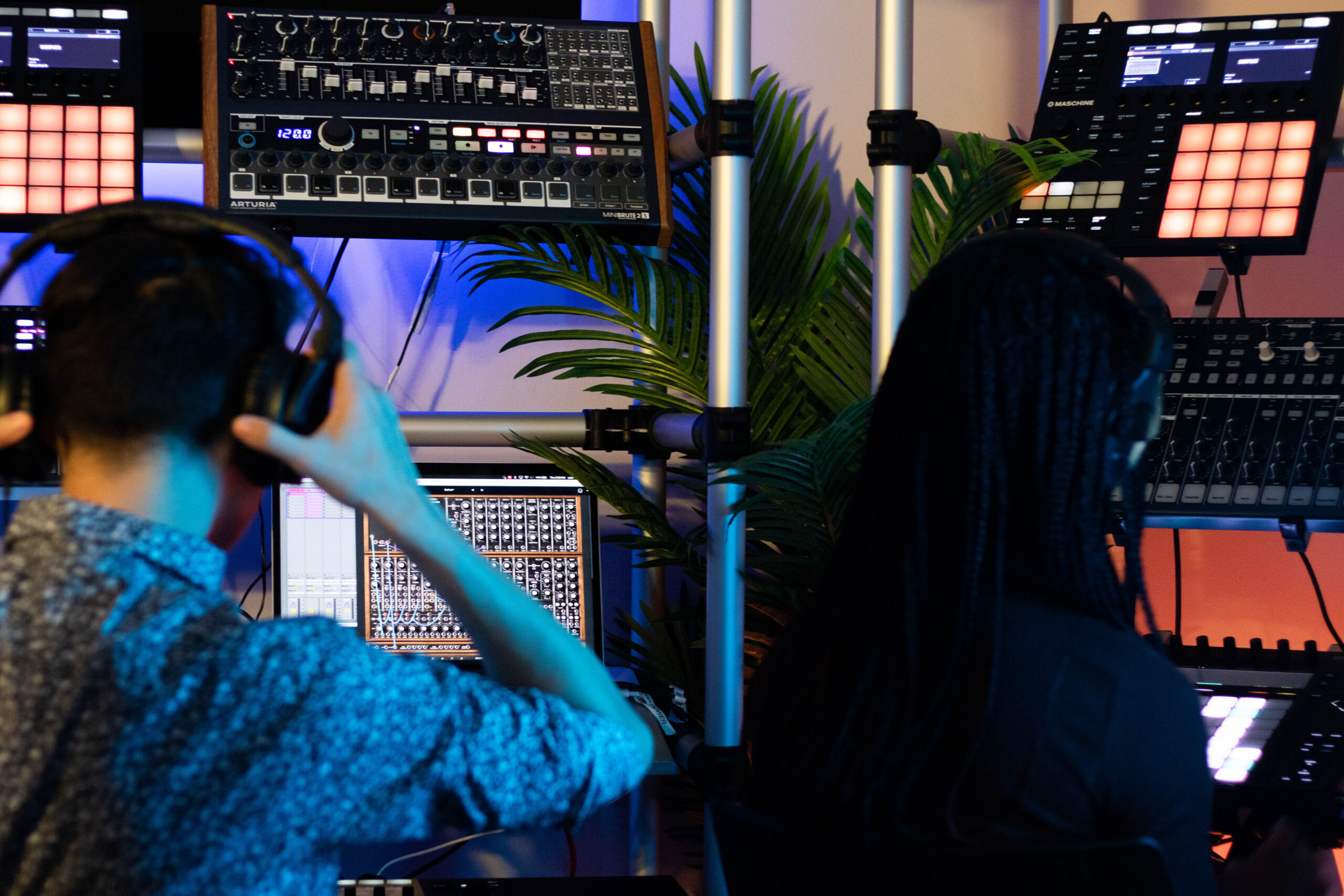
- Hands-on audio production: You learn on controllers, drum machines, synths and studio monitors, and you’re the one touching them. The juggling-pin finding applies here. Handling the real thing gives you a truer sense of what you can and can’t do yet.
- Guided practice: A syllabus puts the fundamentals first, gives arrangement and mixing real class time, and builds each week on the last. You don’t have to decide what to learn next.
- Other producers: Classmates hear the same lesson and solve it in different ways. You hear their versions, trade sessions, and sometimes keep making music together after the course ends.
- A reason to show up: Class is on the calendar and the instructor expects to hear progress. It’s harder to let a track sit for a month when someone will ask about it next week.
In-Person Classes vs YouTube at a glance
| Topic | YouTube Tutorials | In-Person Music Production Classes |
| Cost | Free! Although, you will be seeing quite a few ads in between videos. | Paid per course or per private lesson. |
| Feedback | Rare. Although, you might get lucky if you leave a comment under a video. | Built in. An instructor hears your work in class. |
| Order of Topics | You choose, or the algorithm chooses for you. | Set by a syllabus. |
| Quick searches to specific questions | Excellent. | Limited to class time. |
| Gear and Monitoring | Whatever you have at home. | Professional studio equipment, controllers, and hardware. |
| Schedule | Anytime. | Fixed class times. |
| Accountability | None. | Class dates, classmates, and the instructor. |
| Community | Comment sections and Discord servers. | Classmates in/out of the room. |
Which should you start with?
It depends on where you are now. A few common situations:
- You’ve never opened a DAW: Start with a free workshop or an intro class. Videos jump around, and at the start you can’t tell which basics you’re missing. An intro course covers them in order.
- You’ve been teaching yourself for a year or more and can’t finish tracks: You probably know the tools already. The next step is having someone listen to three or four of your unfinished projects and tell you what they have in common. A class or a private lesson with a working producer does that.
- You have one specific question: Search YouTube. You don’t need a six-week course to find the swing setting.
- You want to make music with other people: Go to a producer event or take a class. Either way, you’ll be in a room with producers at your level.
- You can’t get to a class right now: Keep using YouTube, and find some way to get your tracks heard by a person: a producer friend, a feedback group, or online lessons with a real teacher.
How to use YouTube and in-person classes together
You don’t have to pick one. A few habits get more out of both, whatever stage your music production learning is at.
- Let the class set the order: Use YouTube between sessions to go deeper on whatever came up that week. If your instructor mentions parallel compression, that’s the week to watch three videos on it.
- Watch once, then do it straight away: Close the video and try the technique in your own track, with your own sounds. That’s where you find out whether you understood it.
- Bring your session file to class: If a tutorial left you confused, open the project in class and ask. The instructor can hear the problem in context.
- Keep a list of what you can’t fix: Every time you get stuck and a video doesn’t solve it, write it down. That list becomes your agenda for class or for a private lesson.
What to look for in in-person music production training
- Wherever you learn, these questions will tell you more than a course page will:
- How much of each class will I spend working at my own station, as opposed to watching the instructor’s screen?
- Will the instructor listen to my own work during class?
- Who teaches, and what do they release or work on outside the classroom?
- How many students are in a class?
- Can I come in and practice between classes?
- What does the course assume I already know, and what comes after it?
Where Sound Collective fits
Sound Collective runs in-person music production courses at 28 Broadway in Lower Manhattan. Classes are small, and working NYC producers teach every one.
Intro to Ableton Live and Intro to Logic Pro need no production experience. Each is 12 hours of in-person instruction over four to six weeks. That includes practice time on class days, 6 day passes for the days you’re not in class, and a certificate of completion. The day passes get you into the student lounge, where production stations are set up with hardware like the Moog Mother-32, Elektron Digitone and Roland TR-8S.
After the intro level there are intermediate and advanced courses in both DAWs, with advanced courses focused on dance music, bass music or hip-hop. Piano for Producers, Intro to Synthesis and Music Theory for Producers work with any DAW.
If you want to try it first, the free Production Basics workshop is a two-hour, small-group session where you build your first groove and loop from scratch. No experience needed. For a longer rundown of beginner options, see our guide to the 7 best in-person music production classes for beginners.
FAQs
Can you learn music production from YouTube alone?
You can learn most of the tools from YouTube alone. Self-taught producers usually get stuck on problems specific to their own tracks, like mixes that don’t translate or ideas that never get past 8 bars, because a video can’t hear their music. Feedback from a person, in a class, a lesson or from a producer you trust, is what usually gets those tracks moving.
Are in-person music production classes worth it?
They’re worth it when what’s holding you back is feedback, structure or access to gear. If you only need to know what a setting does, a free tutorial will answer it.
Is YouTube enough to learn Ableton or Logic? For learning where things are and what they do, often yes. Finishing and mixing tracks you’re happy with is harder to learn from videos, because it depends on someone hearing your work.
Why can’t I finish tracks after watching so many tutorials?
Tutorials mostly teach techniques one at a time, and finishing depends on arrangement and on decisions across a whole track. Watching also makes skills feel more learned than they are. In a 2018 study, people who watched a dart-throwing video 20 times felt more confident than people who watched it once, and scored no better.
Is in-person music production education better than learning online?
Neither is better across the board. Online video is better for quick, specific answers and for range. In-person classes are better for feedback on your own work, hands-on time with gear, and a structured order of practice. Many producers use both.
Do in-person classes replace YouTube tutorials?
No. YouTube stays useful as a reference between classes. The class sets what you practice and gives you feedback, and videos answer the quick questions in between.
Should a beginner start with YouTube or a class?
A free workshop or an intro class is the better start for most beginners, because it covers the basics in order and someone can correct mistakes before they become habits. YouTube is useful alongside it.
Do I need experience to take Sound Collective’s intro music production classes?
No. Intro to Ableton Live, Intro to Logic Pro and the free Production Basics workshop need no prior production experience.
Where is Sound Collective?
28 Broadway in Lower Manhattan, right by Bowling Green on the 4/5. Open Monday to Saturday 10am to 9pm, and Sunday 11am to 6pm.
Ready to start?
- Not sure yet? Sign up for a free Production Basics workshop, or book a tour and see the classrooms and lounge for yourself.
- Ready for a course? Browse upcoming in-person music production courses. Most beginners start with Intro to Ableton Live or Intro to Logic Pro.
- Stuck on a specific track? Book a private lesson and bring the session.
- Questions? Call (646) 747-0144.