You don’t learn to produce by watching YouTube
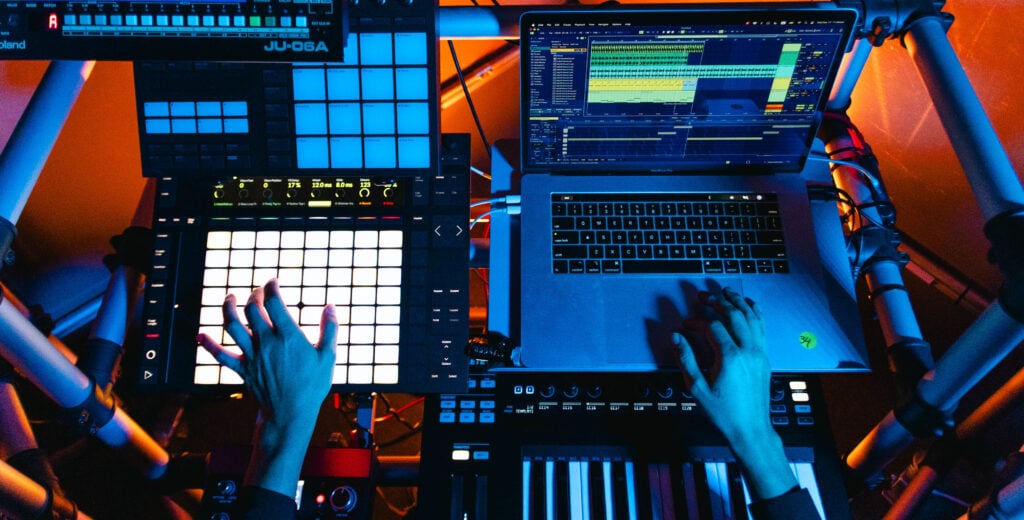
You learn by opening a session, trying something, hitting a wall you can’t solve on your own, and having someone next to you who can point at your screen and fix it in ten seconds. That’s why in-person music production classes still beat any tutorial channel, no matter how many hours are on it.
The hard part is choosing where to go. Beginner music production courses have exploded over the last few years. Most of them market the same way: “learn to produce on industry-standard software.” Cool. So how do you actually pick one?
This guide cuts through that. First, the criteria that separate a good beginner music production class from a forgettable one. Then seven types of in-person production classes worth your time in 2026, who each one is for, and how to start.
How we evaluated beginner music production classes
Before the list, here’s the rubric. Use it for any music production school you’re considering, not just the ones we name.
- A real DAW, on a real workstation. A serious beginner course puts you on Ableton Live, Logic Pro, or FL Studio, running on a proper studio machine with a keyboard, headphones, and monitors. Phone-app “production” classes and free trials on your laptop are not the same environment.
- Hands-on time, not lecture hours. Total course length matters less than how many minutes you actually spend in a session, making something. A 2-hour class where you finish a loop beats a 3-hour class that’s half slides.
- Small class size. Look for a 4 to 6 student cap. Above that, the instructor stops being able to walk to your workstation and troubleshoot your specific problem.
- A working producer or engineer at the front of the room. Teaching matters, but so does credibility. The instructor should have current releases, current sessions, or current mixing credits, not just a bio from 2014.
- A clear next step. A good beginner course tells you what to take next. If a school’s catalog ends at “Intro to Ableton” with no obvious continuation, you’ll finish and plateau within a month.
- Location and schedule that fit your life. Weekly evening or weekend classes over 4 to 6 weeks are the standard because most students can’t take a month off work. Match the format to your actual calendar.
- A path toward finished tracks, not just techniques. Most producers who quit don’t quit because they can’t EQ. They quit because they never finish anything. The best beginner programs are built around getting you to a completed track, not just teaching you tools.
With those in mind, here are the seven options.
1. The Free Production Workshop
Best for: Complete beginners who want to know if music production is actually for them before spending a dollar.
Format: A one-day, hands-on workshop. Usually 2 hours. Often free or very low cost.
Examples of what you’ll learn:
- What a DAW actually is and what the interface does
- How to load a drum sample and program a basic beat
- How to lay a bassline and simple melody on top
- What “finished” even means at this stage
Why it works for beginners: No commitment. If you love it, you have a clear ramp into a multi-week course. If you don’t, you spent a Saturday afternoon instead of six weeks. Every serious student we’ve had came in through a low-stakes first touch. This is the version that costs you nothing.
Where to start at Sound Collective: Our Production Basics free workshop runs bi-monthly. Two hours, no experience needed, real gear.
2. The Intro DAW Course (Ableton or Logic)
Best for: Beginners who’ve decided they want to actually build the skill. You know you’re serious enough to commit six weeks.
Format: Multi-week course, weekly 2-hour sessions. Small class. Real workstations.
What you’ll learn:
- The full DAW interface, not just the parts a tutorial video shows you
- How to arrange a track from a loop into a full structure
- Basic mixing: EQ, compression, gain staging
- How to bounce a clean file that plays anywhere
Why it works for beginners: This is the standard entry point for a reason. Six weeks is long enough to build real muscle memory but short enough that you can commit to it without upending your life. By the last session, you’ll have finished something. That’s the difference between “I dabbled in production” and “I make music.”
The DAW question: Ableton Live is the standard for electronic, dance, and hip-hop producers who want flexible session-based workflows. Logic Pro is the standard for singer-songwriters, band producers, and anyone recording live instruments. Neither is objectively better. Pick based on the music you actually want to make. You can always learn the other one later.
Where to start at Sound Collective: Both intro DAW courses run on a rolling schedule. Check out Intro to Ableton Live or Intro to Logic Pro and get started. Counts toward Full Program enrollment if you decide to upgrade later.
3. The Foundational Musicianship Course (Theory, Piano, Synthesis)
Best for: Beginners who want to actually understand music, not just learn a piece of software. Often the right first course for people with some musical background but no production experience, or for anyone whose beats keep sounding the same.
Format: Multi-week course, weekly 2-hour sessions. Curriculum-heavy.
What you’ll learn:
- Music Theory for Producers: Why your chord progressions work, or don’t, and how to fix them without guessing.
- Piano for Producers: Real keyboard fluency, so you can play chords by hand instead of drawing them into a piano roll one note at a time.
- Intro to Synthesis: How to design your own sounds from scratch instead of scrolling through presets for two hours and giving up.
Why it works for beginners: Most production tutorials skip this entirely. You end up knowing every button in the DAW and still can’t write a melody. The producers who last are the ones who invested in fundamentals early. It’s not glamorous. It compounds.
Where to start at Sound Collective: Music Theory for Producers, Piano for Producers: Intro, and Intro to Synthesis each run as multi-week courses. Take one, or take them in sequence over the year.
4. The Genre-Specific Advanced Course
Best for: Producers who’ve completed an intro DAW course and know what genre they want to make. You’re past general skills and into “I want to finish a house track” or “I want to make a real hip-hop beat.”
Format: Multi-week course, weekly 2-hour sessions. Built around one genre, end-to-end.
What you’ll learn:
- Genre-specific arrangement conventions (intro, drop, breakdown, outro)
- Sub-bass design and low-end management for genres that live in the sub
- Sample selection and chopping for genres built on samples
- Mixing decisions specific to how the genre gets played (club system, headphones, radio)
- A finished, release-ready track by the end of the course
Why it works for beginners: Generic production courses teach you techniques. Genre-specific courses teach you to finish tracks that actually sound like the music you love. That’s a bigger deal than it sounds. Most producers can EQ a kick. Very few can build a full bass music track that competes with what’s on the label they want to release on.
Where to start at Sound Collective: Our advanced tracks split by DAW and by genre. In Ableton: Bass Music or Dance Music. Logic Pro students get the same genre paths (Bass Music or Dance Music) on the Logic side.
5. Private Music Production Lessons
Best for: Producers with a specific project they’re trying to finish, an inconsistent schedule, or a skill that’s blocking everything else. Also good for intermediate producers who’ve hit a plateau.
Format: One-on-one sessions, scheduled around your availability. Pay per session or in packages.
What you’ll learn: Whatever you ask for. That’s the point.
Why it works for beginners: Group classes move at the median pace. Private lessons let you spend two full hours on the one thing that’s blocking you, whether that’s finishing arrangements, getting your mixes to translate, or figuring out why every track you make sounds the same. For some producers, a handful of privates unlocks more progress than months of self-study.
The catch: Privates can get expensive fast, and they’re easier to skip than a group class where classmates expect you. Most students do best with a hybrid: a structured group course to build fundamentals, plus monthly privates for targeted work on your own tracks.
Where to start at Sound Collective: Book a private music production lesson. Tell us what you want to fix, or what track you’re trying to finish. We’ll match you to the right instructor.
6. Custom Group Programs (Schools, Nonprofits, Workforce)
Best for: Educators, after-school program directors, school administrators, and organizations placing a group of beginners into music production training together.
Format: A program built around your group, your timeline, and your budget. Can run on-site at Sound Collective, off-site at your location, or hybrid.
What you’ll learn: Custom curriculum mapped to your program’s goals, from introductory exposure through a multi-week residency to a feeder pipeline into ongoing training.
Why it works for beginners: Group learning at any age is more effective when it’s designed for that specific group. Students who train alongside their peers stay engaged longer, share tools and reference tracks between sessions, and continue producing after the program ends. A custom program also lets you build in equipment access, showcase performances, and follow-on pathways that a standard class can’t offer.
Where to start at Sound Collective: Our custom NYC music programs work with DOE schools, nonprofits, colleges, and private institutions. Reach out for a scoping conversation. We’ve built programs from single one-day workshops to multi-semester residencies.
7. The Full-Time Music Production Program
Best for: Producers who want a career in music. Full stop. You’re not here for a hobby. You want to release records, work in film and TV, produce for other artists, or build a name as a sound designer.
Format: A 12-month, three-section program. You choose Ableton Live or Logic Pro as your primary DAW (or work in both). Every section includes group courses of your choosing, 12 hours of private mentorship, four months of full facility and gear access, and a final project for your portfolio.
What you’ll learn:
The full production stack: sound design, arrangement, mixing, mastering
A working knowledge of the studio side (mic technique, tracking, session workflow)
Music business fundamentals: release strategy, revenue, building an audience
Genre depth: advanced tracks in bass music, dance music, or hip-hop
A finished portfolio of original work you can send to labels, sync agencies, or collaborators
Why it works for beginners: The producers who succeed as professionals almost never get there one short course at a time. They go through an environment where the expectation is serious work and they’re surrounded by other people doing the same. A full-time program is that environment. The private mentorship built into every section is what accelerates it. Group classes teach you techniques. A mentor listening to your track and telling you exactly what’s wrong is what turns a producer into a professional one.
Reality check: This is a real investment. If you’re not going to practice between sessions, this is the wrong path. The qualifying question is simple: are you going to put in reps outside of class? If yes, this is the most direct route from beginner to working producer. If no, start with one of the shorter courses higher on this list.
Where to start at Sound Collective: Talk to our team about the Full Program. Once you enroll, the education team walks you through the exact course list based on your goals and schedule, then registers you for your first section together.
How to choose
If you’re stuck between options, here’s the short version:
- You’re not sure production is for you yet: Start with #1, the free workshop.
- You know you want to commit but haven’t picked a DAW: #2, and pick based on the music you actually want to make.
- You have some musical background but the tech is new: #3. Fundamentals will compound faster than DAW tricks.
- You’ve done an intro and want to finish tracks in your genre: #4.
- Your schedule is unpredictable, or you’re stuck on something specific: #5.
- You’re placing a group, not enrolling as an individual: #6.
- Career track. You want production to be your work: #7.
Most beginners do best by combining two of these. A free workshop, then a multi-week intro. An intro DAW course, then monthly privates while you work on your first real track. A foundational musicianship course, then a genre-specific advanced course six months later. The point is to keep going past the first finished loop.
FAQs
How long does it take to learn music production? Most people can finish a basic loop in the first few hours of a real beginner class. Getting to the point where you can produce a full track from scratch takes about 6 months of consistent practice. Getting good enough to release music people actually want to listen to takes years, and it never really stops.
Do I need to own gear or a laptop before I take an in-person class? No. A reputable in-person production class provides the workstations, DAW licenses, headphones, and monitors. You’ll spend the first month or two on the school’s setup, which gives you time to figure out what to buy for home practice.
Ableton vs Logic vs FL Studio, which one should I learn first? Ableton is the standard for electronic and dance producers. Logic is the standard for singer-songwriters and producers recording live instruments. FL Studio is the standard for a lot of hip-hop and trap producers. None is objectively better. Pick based on the music you actually want to make. You can always learn a second DAW later.
Are online music production courses just as good? Online courses are useful as supplements, especially for learning from a specific producer whose sound you love. They are not a substitute for in-person time on real gear with a working producer giving you live feedback. Use them to deepen specific skills between in-person sessions. Sound Collective’s on-demand catalog includes courses from Just Blaze, Larry Ohh, Zach Kornhauser, and ProperVillains, among others.
How much should a beginner music production course cost? Free intro workshops are widely available and worth taking. Multi-week beginner courses typically run in the high hundreds to low thousands. Full-time career-track programs are a five-figure investment. Price is a poor proxy for quality. Class size, instructor experience, and hands-on time are better signals.
What’s the best music production school near me in NYC? We’re biased, but we built Sound Collective at 28 Broadway specifically for the beginner-to-working-producer pipeline this article describes. Come tour the space and decide for yourself.
Ready to start?
The hardest part of learning music production isn’t the DAW. It’s opening a session for the first time with someone who can actually help.
If you’re in NYC, book a tour of Sound Collective. We’ll show you the production labs, the recording studios, the mixing rooms, and the DJ studio. We’ll walk you through the right course for where you are, and answer anything this guide didn’t cover. There’s no pressure to enroll. Most of our students take the tour, go home and think about it, and come back when they’re ready.
If you’re not in NYC, use the criteria at the top of this article to evaluate any school you’re considering. Real DAW on real workstations, hands-on hours, small class size, working instructors, a clear next step, a path to a finished track. If a school can’t show you those on a tour, keep looking.
Either way, start.