Learn to produce music in a real studio, with a real teacher in the room.
Sound Collective runs small in-person music production classes at 28 Broadway. You work in professional rooms, on professional gear, with working producers guiding you from your first session to finished tracks.
- 28 Broadway, New York
- Small classes
- Real sessions from day one
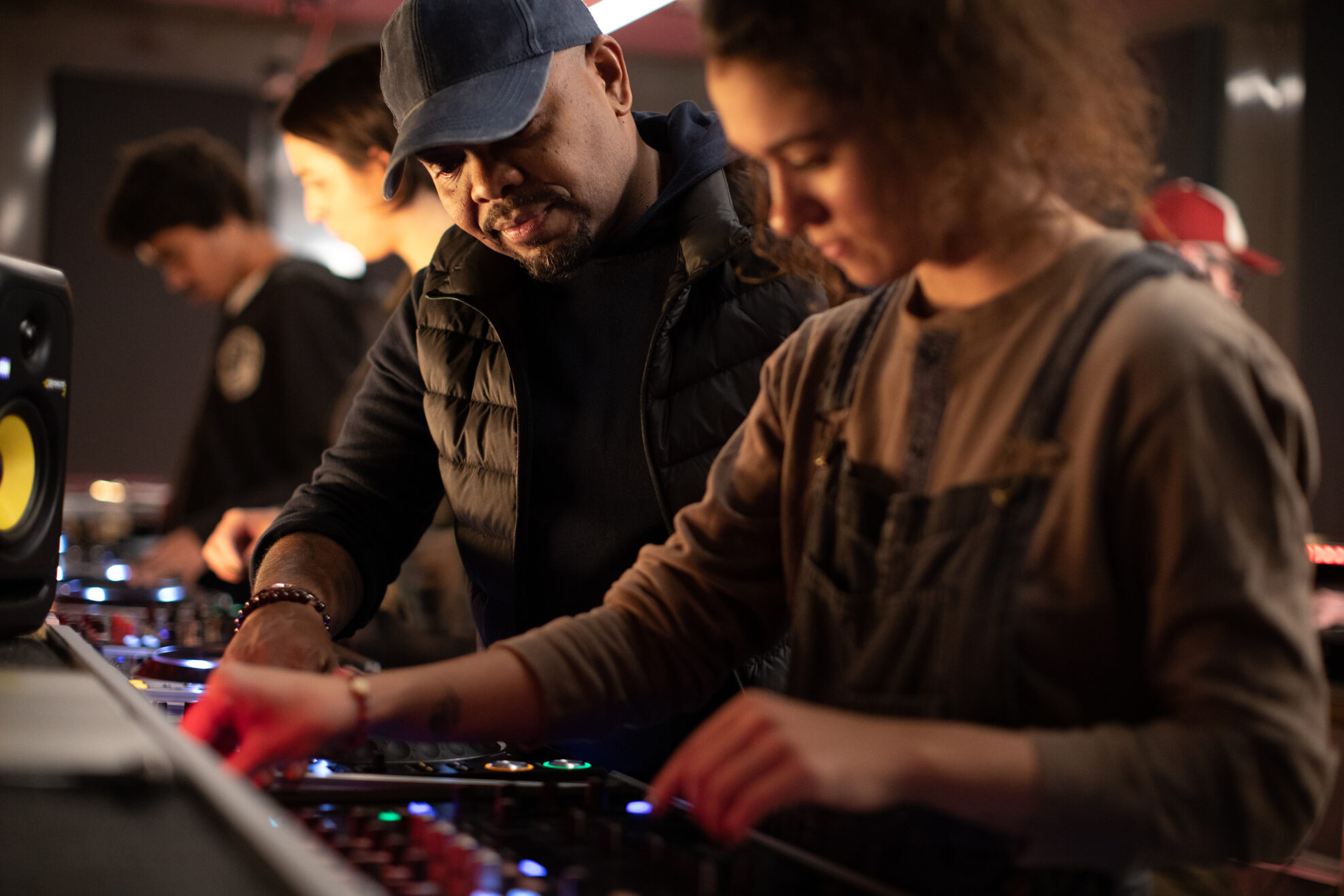
Working NYC producers teach every class. Small groups mean you’re at the desk, not watching from a chair. You leave every session having made something.
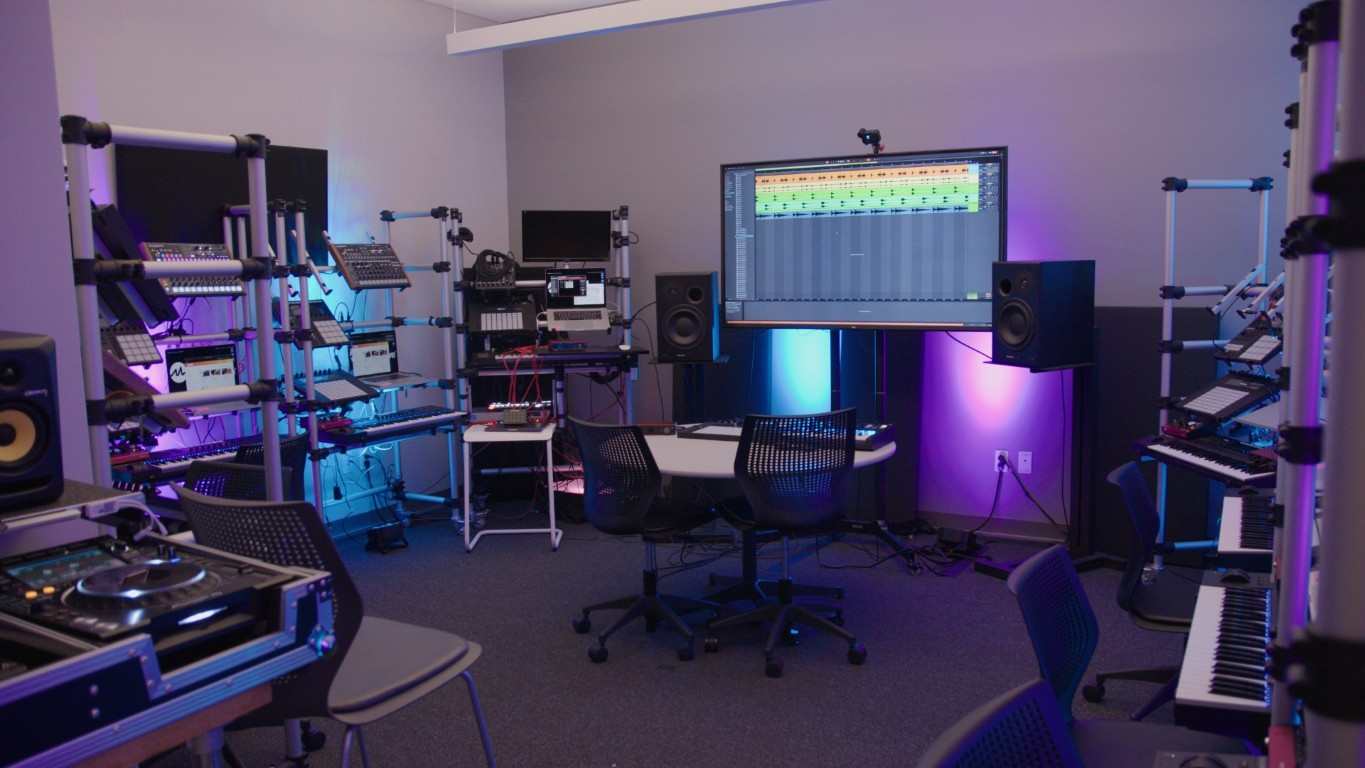
Every idea you hear in your head can become a finished track. Production is the skill that turns taste into music, and it compounds: each class builds on the last.
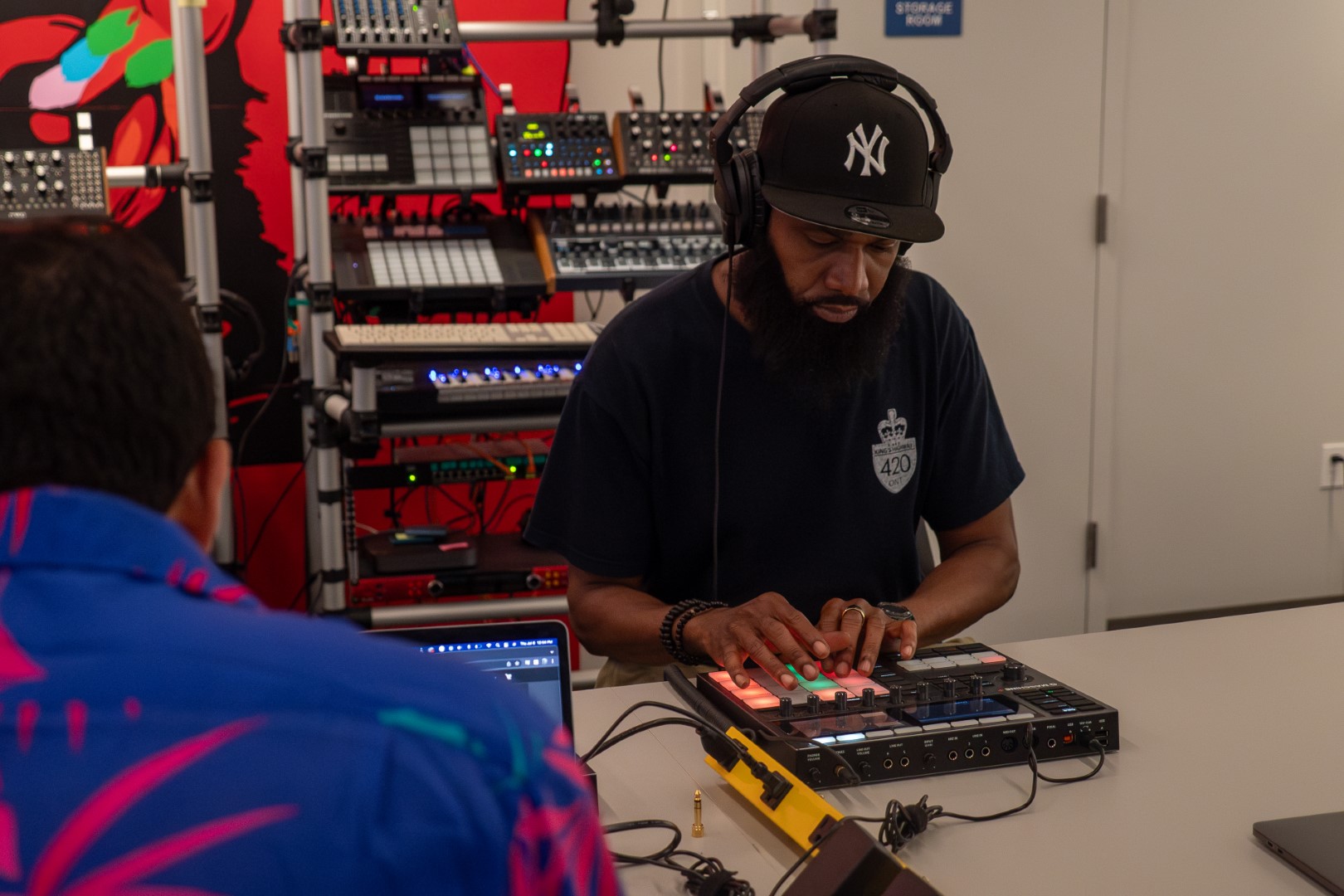
No pre-recorded videos. You sit in the room, ask questions in the moment, and get feedback on your actual project while you work on it.
Find your starting point
Have you produced music in a DAW before?
Answer one question and we’ll show you exactly which classes fit where you are right now.
Which DAW do you use?
We teach dedicated tracks for both. Pick yours and we’ll show the full course path.
Every producer starts by choosing a DAW
A DAW (digital audio workstation) is the software you’ll make music in. We teach the two industry standards. Here’s the honest difference:
Ableton Live
- Session View lets you sketch loops fast, before committing to a full arrangement.
- The standard for house, techno, hip-hop, and most electronic genres.
- Runs on both Mac and Windows.
- Doubles as a live performance instrument later on.
Logic Pro
- A timeline-first workflow that feels natural if you think in songs.
- A massive built-in instrument and sound library, no extra purchases.
- Mac only, one-time purchase.
- A favorite for songwriters and vocal-forward production.
Torn between them? ask our team and we’ll settle it in one conversation.
Which one sounds like you?
You can’t pick wrong. The skills transfer, and our intro classes assume zero experience either way.
Still deciding? Ask our team and we will settle it in one conversation.
Your Ableton learning path, mapped
Two kinds of classes make a complete producer. DAW Training teaches you the instrument (the DAW itself, in sequence). Producer Skills teaches you the musicianship behind it, and applies no matter what software you use.
Learn Ableton Live
Master the software itself, from first session to release-ready tracks.
- 1 Intro to Ableton Live First finished song plus fluency in the full feature set
- 2 Intermediate Ableton Precision warping, drum systems, racks, arrangement strategy
- 3 Advanced Ableton Bass, Dance, or Hip-Hop concentration, release-ready
Each level builds on the last. Start where your experience puts you.
Learn the musicianship
Software-agnostic skills that make everything you produce better.
- Piano for Producers Play your ideas in real time instead of drawing them
- Intro to Synthesis Sound design fundamentals for every synth and VST
- Music Theory for Producers Theory as a production tool, applied in the DAW
These pair with any DAW level. Most students add one alongside Intermediate.
Ableton-specific courses. These run in sequence: each level assumes the skills from the one before it.
For you if: you’re a complete beginner drawn to electronic, dance, hip-hop, or any genre where the DAW is part of the creative process.
Taught by a working NYC producer
- Audio Editing & Warping. Align, loop, and reshape audio so ideas lock to tempo.
- Automation & Mixing. Add movement and deliver a balanced, shareable master.
- DAW Navigation. Develop speed and organisation to drive your creativity.
- MIDI & Drum Rack. Program rhythmic and melodic parts that drive the track.
- Sampling with Simpler. Turn found sounds into playable, expressive instruments.
- Synthesis & FX. Design original tones and shape space with effects.
For you if: you completed Intro to Ableton (or match its skills) and you’re ready to take more control.
Taught by a working NYC producer
- Arrangement Strategy. Turn loops into songs with contrast and intentional energy arcs.
- Drum Systems & Slicing Racks. Build playable kits with punch and character.
- Precision Warping & Slicing. Correct timing and reshape audio with musical feel.
- Ableton Mix Systems. Deliver balanced mixes with clear low end.
- Instruments & Rack Architecture. Design multi-device chains and expressive sampler instruments.
- Automation & Modulation Depth. Shape movement with clip and track lanes.
For you if: you completed Intermediate Ableton and want release-ready dance music. Pick one concentration.
Taught by a working producer in your concentration's genre
- Arrangement Strategy. Turn loops into songs with contrast and intentional energy arcs.
- Drum Systems & Slicing Racks. Build playable kits with punch and character.
- Precision Warping & Slicing. Correct timing and reshape audio with musical feel.
- Ableton Mix Systems. Deliver balanced mixes with clear low end.
- Instruments & Rack Architecture. Design multi-device chains and expressive sampler instruments.
- Automation & Modulation Depth. Shape movement with clip and track lanes.
For you if: you completed Intermediate Ableton and want release-ready bass music. Pick one concentration.
Taught by a working producer in your concentration's genre
- Arrangement Strategy. Turn loops into songs with contrast and intentional energy arcs.
- Drum Systems & Slicing Racks. Build playable kits with punch and character.
- Precision Warping & Slicing. Correct timing and reshape audio with musical feel.
- Ableton Mix Systems. Deliver balanced mixes with clear low end.
- Instruments & Rack Architecture. Design multi-device chains and expressive sampler instruments.
- Automation & Modulation Depth. Shape movement with clip and track lanes.
For you if: you completed Intermediate Ableton and want release-ready hip-hop. Pick one concentration.
Taught by a working producer in your concentration's genre
- Arrangement Strategy. Turn loops into songs with contrast and intentional energy arcs.
- Drum Systems & Slicing Racks. Build playable kits with punch and character.
- Precision Warping & Slicing. Correct timing and reshape audio with musical feel.
- Ableton Mix Systems. Deliver balanced mixes with clear low end.
- Instruments & Rack Architecture. Design multi-device chains and expressive sampler instruments.
- Automation & Modulation Depth. Shape movement with clip and track lanes.
DAW-agnostic courses. No DAW required in the title because none is required in the room: these skills transfer to any software, forever.
For you if: you want to play your ideas instead of brute-forcing them with a mouse in the piano roll. No classical background required.
Taught by a working NYC producer
- Keyboard Mechanics. Build efficient hand shape and finger control.
- Scales and Triads. Connect scale shapes to chord building.
- Melody-Bass Coordination. Balance melody with bass to outline harmony.
- Pulse and Timing. Lock groove and subdivision.
- Chord Progressions. Create functional movement and smooth transitions.
For you if: you want to stop being locked to presets and start designing your own sounds. These fundamentals work on every synth, VST, and hardware instrument.
Taught by a working NYC producer
- Effects & Creative Routing. Add space, colour, and motion with FX chains.
- Envelopes & Articulation. Define how sound evolves over time.
- Filters & Subtractive Sculpting. Define usable tone through frequency control.
- Custom Patch Design. Build a toolkit of sounds you can call your own.
- LFOs & Modulation. Route expression and dynamic movement.
- Oscillators & Wavetable. Shape tone at the source.
For you if: you have no formal theory training and want fluency, not conservatory knowledge. This is a production class that uses theory as a tool.
Taught by a working NYC producer
- Arrangement & Structure. Organise sections to tell a clear story.
- Harmony & Progressions. Set mood and motion with functional harmony.
- Melody & Hooks. Craft memorable lines.
- Keys & Scales. Keep ideas melodic and coherent.
- Music Theory. Keep ideas melodic and coherent.
- Rhythm & Groove. Program feel that drives energy and movement.
Your Logic learning path, mapped
Two kinds of classes make a complete producer. DAW Training teaches you the instrument (the DAW itself, in sequence). Producer Skills teaches you the musicianship behind it, and applies no matter what software you use.
Learn Logic Pro
Master the software itself, from first session to release-ready tracks.
- 1 Intro to Logic Pro First finished song plus fluency in instruments, MIDI, mixing
- 2 Intermediate Logic Deep instruments, advanced MIDI, mixing depth, arrangement
- 3 Advanced Logic Bass, Dance, or Hip-Hop concentration, release-ready
Each level builds on the last. Start where your experience puts you.
Learn the musicianship
Software-agnostic skills that make everything you produce better.
- Piano for Producers Play your ideas in real time instead of drawing them
- Intro to Synthesis Sound design fundamentals for every synth and VST
- Music Theory for Producers Theory as a production tool, applied in the DAW
These pair with any DAW level. Most students add one alongside Intermediate.
Logic-specific courses. These run in sequence: each level assumes the skills from the one before it.
For you if: you’re a Mac-using beginner, a traditional songwriter, or a producer who wants a musician-friendly workflow.
Taught by a working NYC producer
- Audio Recording & Editing. Record and shape audio performances.
- Arrangement & Automation. Add movement and deliver a shareable master.
- DAW Navigation. Develop speed and organisation to drive your creativity.
- Mixing & Effects. Balance and clarity make a demo sound release-ready.
- MIDI & Instrument Setup. Use Logic’s instruments to build melodic and rhythmic parts.
For you if: you completed Intro to Logic (or match its skills) and you’re ready to specialize.
Taught by a working NYC producer
- Arrangement & Section Building. Turn ideas into complete songs.
- Advanced Automation. Add movement and dynamics.
- Export & Delivery. Deliver mixes ready for feedback and release.
- Mixing & Balance. Create clarity and depth.
- Advanced Audio & MIDI Editing. Refine recordings with precision and musicality.
- Instruments & Sound Design. Explore Logic’s instruments for unique sonic character.
For you if: you completed Intermediate Logic and want release-ready dance music. Pick one concentration.
Taught by a working producer in your concentration's genre
- Arrangement & Section Building. Turn ideas into complete songs.
- Advanced Automation. Add movement and dynamics.
- Export & Delivery. Deliver mixes ready for feedback and release.
- Mixing & Balance. Create clarity and depth.
- Advanced Audio & MIDI Editing. Refine recordings with precision and musicality.
- Instruments & Sound Design. Explore Logic’s instruments for unique sonic character.
For you if: you completed Intermediate Logic and want release-ready bass music. Pick one concentration.
Taught by a working producer in your concentration's genre
- Arrangement & Section Building. Turn ideas into complete songs.
- Advanced Automation. Add movement and dynamics.
- Export & Delivery. Deliver mixes ready for feedback and release.
- Mixing & Balance. Create clarity and depth.
- Advanced Audio & MIDI Editing. Refine recordings with precision and musicality.
- Instruments & Sound Design. Explore Logic’s instruments for unique sonic character.
For you if: you completed Intermediate Logic and want release-ready hip-hop. Pick one concentration.
Taught by a working producer in your concentration's genre
- Arrangement & Section Building. Turn ideas into complete songs.
- Advanced Automation. Add movement and dynamics.
- Export & Delivery. Deliver mixes ready for feedback and release.
- Mixing & Balance. Create clarity and depth.
- Advanced Audio & MIDI Editing. Refine recordings with precision and musicality.
- Instruments & Sound Design. Explore Logic’s instruments for unique sonic character.
DAW-agnostic courses. No DAW required in the title because none is required in the room: these skills transfer to any software, forever.
For you if: you want to play your ideas instead of brute-forcing them with a mouse in the piano roll. No classical background required.
Taught by a working NYC producer
- Keyboard Mechanics. Build efficient hand shape and finger control.
- Scales and Triads. Connect scale shapes to chord building.
- Melody-Bass Coordination. Balance melody with bass to outline harmony.
- Pulse and Timing. Lock groove and subdivision.
- Chord Progressions. Create functional movement and smooth transitions.
For you if: you want to stop being locked to presets and start designing your own sounds. These fundamentals work on every synth, VST, and hardware instrument.
Taught by a working NYC producer
- Effects & Creative Routing. Add space, colour, and motion with FX chains.
- Envelopes & Articulation. Define how sound evolves over time.
- Filters & Subtractive Sculpting. Define usable tone through frequency control.
- Custom Patch Design. Build a toolkit of sounds you can call your own.
- LFOs & Modulation. Route expression and dynamic movement.
- Oscillators & Wavetable. Shape tone at the source.
For you if: you have no formal theory training and want fluency, not conservatory knowledge. This is a production class that uses theory as a tool.
Taught by a working NYC producer
- Arrangement & Structure. Organise sections to tell a clear story.
- Harmony & Progressions. Set mood and motion with functional harmony.
- Melody & Hooks. Craft memorable lines.
- Keys & Scales. Keep ideas melodic and coherent.
- Music Theory. Keep ideas melodic and coherent.
- Rhythm & Groove. Program feel that drives energy and movement.